



What's the Difference Between GC-MS and IMR-MS?
As environmental regulations become more stringent, the focus of environmental monitoring is shifting beyond analytical accuracy.
Today, the key question is no longer "Can we analyze the sample?" but rather "Can we measure it in real time, at the right place, and at the right moment?"
This growing demand has led to increasing interest in IMR-MS (Ion Molecule Reaction Mass Spectrometry) for real-time environmental monitoring.
In this article, we explore the differences between GC-MS and IMR-MS, and why each technology serves a unique role in modern analytical applications.
Environmental monitoring is no longer limited to laboratory-based sample analysis.
Industries today require analytical systems capable of:
Real-time monitoring
Continuous measurement
On-site analysis
Rapid decision-making
Applications such as:
Ambient air monitoring
Industrial emission monitoring
Indoor Air Quality (IAQ) assessment
Odor monitoring
Process gas monitoring
Environmental emergency response

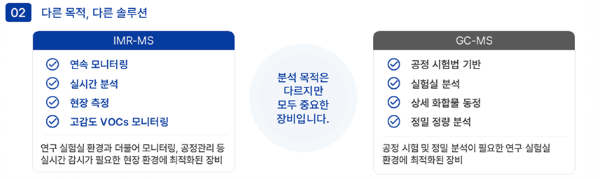
GC-MS vs. IMR-MS: Different Purposes, Different Strengths
Both GC-MS (Gas Chromatography-Mass Spectrometry) and IMR-MS (Ion Molecule Reaction Mass Spectrometry) are powerful analytical technologies.
However, they are designed for different objectives.
GC-MS separates compounds using gas chromatography before mass spectrometric detection, making it highly suitable for detailed laboratory analysis and compound identification.
In contrast, IMR-MS enables direct, real-time gas analysis without sample pretreatment, making it ideal for continuous monitoring and rapid field applications.
Rather than competing technologies, GC-MS and IMR-MS complement each other, each serving different analytical needs.

GC-MS is widely used for:
Laboratory analysis
Compound identification
Detailed qualitative and quantitative analysis
Regulatory testing
Research applications

Key Features of ACE 1100 IMR-MS
Direct analysis without sample pretreatment
Continuous real-time monitoring
Detection of VOCs at low concentration levels (ppb to ppt, depending on the target compound and measurement conditions)
Suitable for both fixed installations and mobile analytical platforms
These capabilities make IMR-MS an effective solution for monitoring dynamic environmental conditions.

Why Real-Time Monitoring Matters
Environmental conditions are constantly changing.Gas concentrations in industrial facilities, indoor environments, or ambient air can fluctuate within minutes.
A single laboratory measurement provides only one point in time, whereas continuous monitoring enables users to:
Track concentration trends
Detect abnormal conditions early
Respond quickly to potential risks
Build long-term environmental datasets

Mobile Lab: Bringing the Laboratory to the Field
Young In ACE also offers the Mobile Lab, a vehicle-based analytical platform integrating the ACE 1100 IMR-MS for field deployment.
Instead of transporting samples back to a laboratory, the Mobile Lab enables immediate on-site analysis for applications including:
Ambient air monitoring
Industrial environmental monitoring
Odor investigation
Indoor air quality assessment
Emergency environmental response
Different Technologies for Different Analytical Objectives
GC-MS and IMR-MS are not competing technologies—they address different analytical requirements.
GC-MS excels in detailed laboratory-based chemical analysis.
IMR-MS is optimized for real-time monitoring and field applications.
Selecting the appropriate technology depends on the analytical objective, sampling environment, and operational requirements.
Young In ACE's Real-Time Monitoring Solution
Through the ACE 1100 IMR-MS (Ion Molecule Reaction Mass Spectrometer) and the Mobile Lab, Young In ACE provides advanced real-time analytical solutions for:
Environmental monitoring
Industrial safety
Process monitoring
Indoor air quality assessment
As the demand for continuous environmental data continues to grow, Young In ACE remains committed to developing innovative real-time monitoring technologies that support safer industries and smarter environmental management.
|
댓글 0.00 (0 Review)